
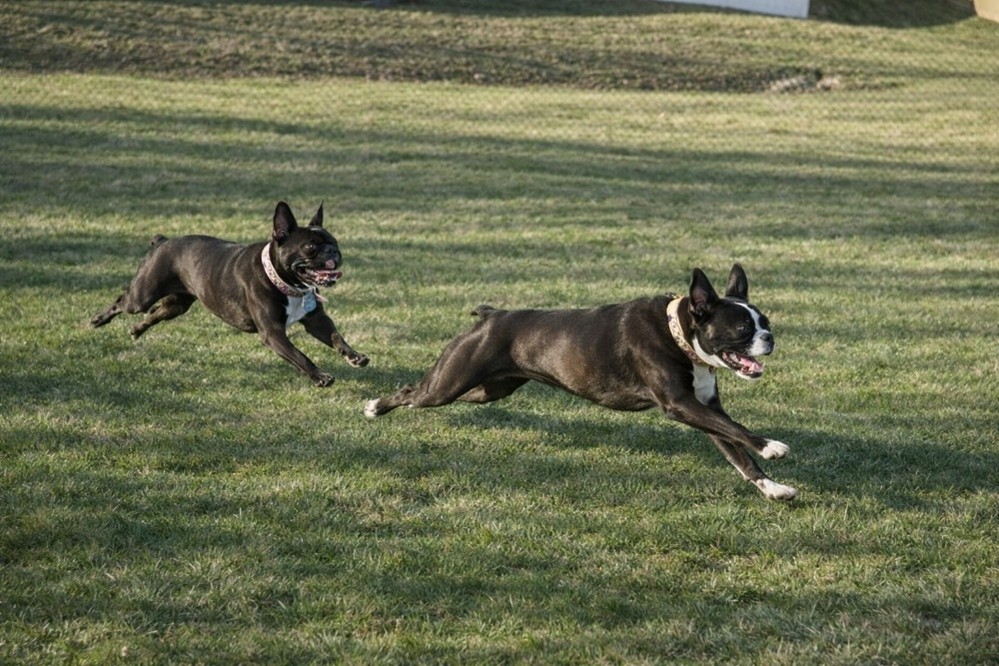
A few days ago, I was standing on my deck watching the girls as they were in the yard theoretically “doing their bidness.” As they went flying by – Mimi chasing Maisy – I found myself thinking,
“Someday I’d love to run like that! Full out and full of joy!”
That simple thought started me down an interesting little trail that eventually became this post.
With all the heaviness we’ve addressed in recent weeks, I thought we all (myself included) could use something a little more light-hearted.
And yet…there’s always a message!
Here’s the best way I can take you along on this slightly crazy conversation I had in my head after watching my girls frolic. Feel free to make it audience participation – or at the very least, let it send you down a similar path of your own.
These were my semi-random thoughts:
- “In Heaven, I bet I could run like that.
- Wait…maybe I should pick something faster.
- I’d like to run like a cheetah!
- Well, as long as I’m ‘heaven-dreaming,’ what else would I wish for?
- Flying always seems pretty amazing, so I’d like to soar like an eagle.
- Hmmm…what other abilities would I like to perfect in Heaven?
- I know – I’d like to climb like a monkey!
- Or hear like an owl.
- And I love the water, so it would be incredible to frolic in the ocean like a dolphin. With my other dolphin friends, of course!”
That’s about where I ended this little rabbit trail – sticking strictly to the animal kingdom.
I like that focus because it feels a bit more whimsical than our usual Heaven wishes.
Of course, we all love the idea of seeing our loved ones again, worshiping God around his throne, and seeing Jesus face-to-face. And who doesn’t long for no more sorrow, no more tears, no more sin?
That’s the vision we cling to in this fallen world.
But isn’t it fun to stretch that into God’s other creation – the animal kingdom?
Do I think we will all have those abilities? Honestly, I have no idea.
And whatever my imagination comes up with, I know it won’t be even a whisper of how incredible Heaven will truly be.
But I do believe God endowed us with imaginations for a reason. And I have to think he smiles when we try to picture Paradise.
He knows we won’t get it all right. But there’s value in thinking on these things.
It stretches us.
It draws our hearts toward Heaven.
It reminds us that something far better is coming.
And here’s the beautiful part:
We can long for Heaven and remain fully committed to the work God has for us here.
Those things aren’t in conflict.
In fact, spending time imagining the greatness of Heaven – and especially our eternity on a restored Earth – can actually enrich how we live today.
It helps us see this world, with all its heartache and brokenness, from a higher perspective.
We still see the pain. We still feel it deeply.
But we also remember:
God will restore it all.
One day anything that you imagined Heaven could be will be replaced by a reality far greater than our feeble human minds could ever create.
As I was pondering all of this, I was reminded of a song sung by Brad Paisley and Dolly Parton over 20 years ago entitled “When I Get Where I’m Going.”
And I smiled, realizing I’m not alone in my Heaven ponderings.
When I get where I’m going,
On the far side of the sky.
The first thing that I’m gonna do
Is spread my wings and fly.
I’m gonna land beside a lion
And run my fingers through his mane.
Or I might find out what it’s like
To ride a drop of rain.
So, here’s my question for you:
When you get to Heaven…what do you want to do?
Let your imagination run a little wild. Where does it take you?
If you’re reading this on Facebook, I’d love to hear your ideas – especially your “animal kingdom’ ones!
And then, thank God for that imagination.
Because whatever we come up with, we can be absolutely sure of this:
He will far surpass it all.
No eye has seen, no ear has heard,
and no human mind has conceived—
the things God has prepared for those who love him.
1 Corinthians 2:9